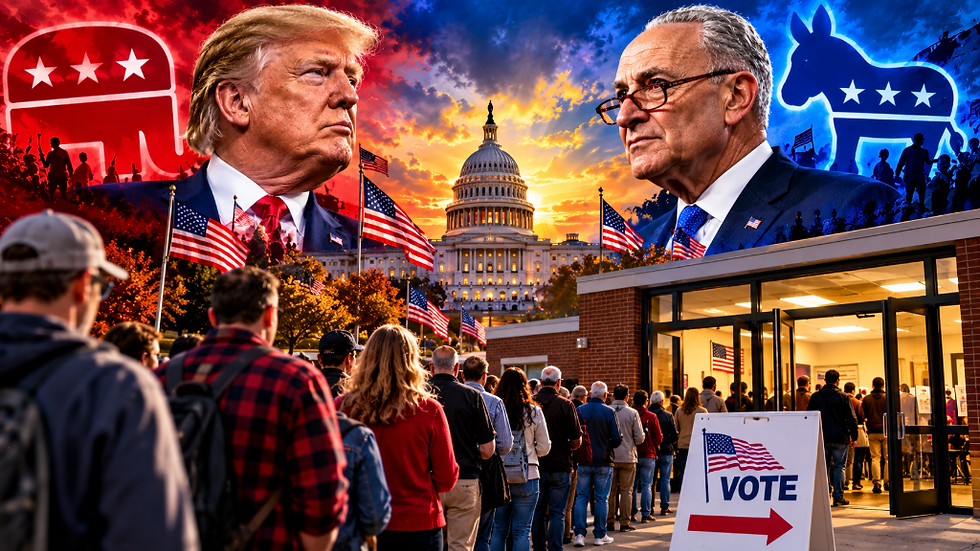
Republicans Fight to Protect Razor-Thin House Majority as Democrats Target Trump's Washington Agenda

WASHINGTON, D.C. — Republicans are entering the final week of the 2026 midterm campaign with one of the narrowest House majorities in modern American politics, setting the stage for a dramatic November 3 election that could determine the future of President Donald Trump's domestic agenda.
All 435 seats in the U.S. House of Representatives are on the ballot, giving voters the opportunity to decide whether Republicans retain legislative control or Democrats gain the power to challenge the administration more directly.
House Speaker Mike Johnson is leading a Republican conference that currently includes 218 members, while Democrats hold 214 seats. One independent generally supports Johnson, and two seats are vacant.
The close division leaves little room for Republican losses.
Control of Congress could change the direction of Washington
For Republicans, retaining the House is essential to advancing legislation on taxation, immigration, energy production, and federal spending.
A Democratic takeover would place the House under different leadership, giving Democrats control over committees, legislative scheduling, and major oversight investigations.
Such a shift could significantly complicate Trump's efforts to enact additional domestic policies during the second half of his presidential term.
Democrats argue that winning the House would provide a necessary check on presidential power and allow Congress to scrutinize administration decisions more aggressively.
Republicans counter that continued unified leadership would provide greater consistency in federal policymaking.
Economic concerns threaten Republican incumbents
Despite the advantages of incumbency, Republican candidates are confronting a difficult political environment.
Economic pressures, including gasoline prices and concerns related to tariffs and the conflict involving Iran, have become prominent campaign issues.
Some Republican incumbents in districts previously considered relatively secure now face unexpectedly competitive contests.
Among those drawing attention are Representative Lauren Boebert of Colorado and Representative Brad Finstad of Minnesota. Democrats are attempting to capitalize on dissatisfaction with national economic conditions, while Republicans are emphasizing their preferred approaches to taxes, border enforcement, and business investment.
Johnson's leadership faces a defining test
Johnson's challenge is not simply to win competitive districts but to preserve enough seats to maintain a functioning governing majority. A narrow Republican victory could leave the speaker confronting many of the same internal divisions and difficult legislative negotiations that have shaped the current Congress.
A larger majority, by contrast, could provide additional flexibility for advancing the administration's priorities.
The outcome will also affect congressional oversight, federal budget negotiations, and the direction of future legislation.
November 3 could redraw the balance of power
The final campaign week will test whether Republican candidates can persuade voters to maintain their current congressional representation despite dissatisfaction with economic conditions. Democrats are seeking to turn that dissatisfaction into victories in suburban districts and other competitive areas.
Capitol Times Media Analysis: Republicans face a difficult but consequential challenge. Preserving the House majority would maintain an important legislative foundation for Trump's agenda, while losing it could fundamentally change the administration's relationship with Congress.