Kevin Lincoln Takes Conservative Fight to California’s Central Valley, Pledging Relief for Families, Farms and Forgotten Communities

CENTRAL VALLEY, Calif. — Republican congressional candidate Kevin Lincoln is making his case for California’s 13th Congressional District with a message built around affordability, water rights, rural health care, faith and public service — arguing that the concerns facing Central Valley families are bigger than partisan labels.
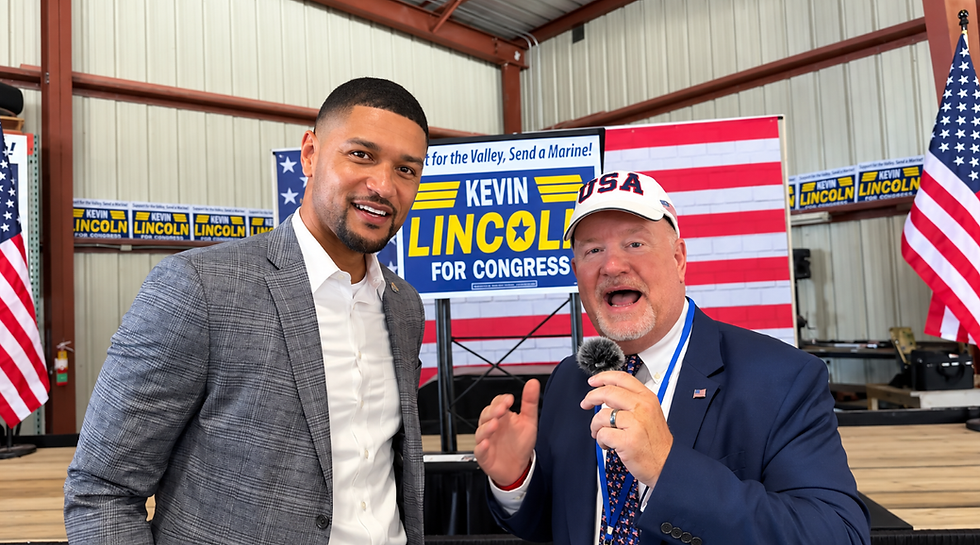
Speaking exclusively with Capitol Times Media in California’s Central Valley, Lincoln said his experience in elected office and community service has taught him how to reach voters even in heavily Democratic territory.
The interview came at an event attended by House Speaker Mike Johnson and Republican leadership, signaling the importance Republicans are placing on the race.
Capitol Times confronted Lincoln with the political reality facing conservative candidates in California.
“I just listened to a phenomenal speech,” the Capitol Times Scott Shields told Lincoln, noting the presence of Speaker Johnson and Republican leaders. “So you’ve got some support here, and I can see why.”
But the Scott Shields then turned to the larger challenge.
“Tell me how you’re going to get the votes here in this Valley,” he asked. “This is California, and it’s generational now, of a lot of indoctrination that you know about.”
He then asked Lincoln directly whether his message was resonating with younger Californians and voters in their 30s and 40s.
Lincoln’s response was clear: Republicans cannot simply depend on partisan loyalty. They have to earn votes by addressing the problems affecting people’s daily lives.
Lincoln: ‘We Know What It Takes to Reach Voters’
Lincoln pointed immediately to his previous political experience.
“Well, I’ll tell you, this isn’t my first time running for office or even being an elected official,” Lincoln said.
He recalled running for mayor of Stockton in 2020, where he had to communicate with an electorate that leaned heavily Democratic.
“I really had to connect with a city that was a deep blue city,” Lincoln said.
That experience, he argued, taught him how to campaign beyond the Republican base.
“We know what it takes to work hard,” Lincoln said. “We know what it takes to reach voters.”
For Lincoln, the answer is focusing on issues instead of assuming party identification determines everything.
“And that’s focusing on the issues that matter most to them,” he said.
Lincoln added that his goal is to represent the entire district.
“Whether you’re a Republican, a Democrat, an independent, you can trust that Kevin Lincoln is a leader,” he said. “He’s a public servant.”
That is a significant message for a Republican campaigning in California.
Lincoln is not asking only Republicans to support him. He is making the case that conservative leadership can appeal to Democrats and independents when government focuses on practical results.
‘Lowering the Cost of Living’
Among the issues Lincoln identified, one stood at the center of concerns confronting families across the district: affordability.
He pledged to be “a champion for those issues that matter most to the people,” including “lowering the cost of living.”
He also pointed to health care access in the Central Valley, particularly for rural communities.
“Whether that’s expanding our health care throughout the Central Valley because we have a lot of rural communities here, and we need more access,” Lincoln said. “We need more providers.”
His comments highlight a political reality sometimes lost in California’s statewide debates: the Central Valley is not Los Angeles or San Francisco.
Its communities include agricultural towns, rural families and working-class residents whose priorities can look very different from those dominating California’s coastal political centers.
Lincoln’s pitch is that Washington should be paying closer attention to them.
‘Protecting Our Water and Our Water Rights’
Few issues are more closely tied to life in California’s Central Valley than water.
Lincoln made clear that it would be one of his priorities in Congress.
“Or whether it’s protecting our water and our water rights and to keep the water flowing to our farms and our faucets,” Lincoln said, “I’m going to carry that mantle on behalf of the people of this district.”
For Central Valley residents, water is not merely another government policy debate.
It affects farms, jobs, communities, households and the future of one of America’s most important agricultural regions.
That gives Lincoln an issue with the potential to reach voters well beyond the Republican Party.
A farmer worried about water does not stop needing water because of party registration.
A family struggling with expenses does not experience the cost of living as a partisan abstraction.
And a rural resident unable to find adequate medical care does not care whether the solution carries a Republican or Democratic label.
Lincoln’s campaign is attempting to capitalize on precisely that reality.
From Pastor to Public Servant
Lincoln also spoke openly about his faith and the years he spent serving his community before entering political life.
Asked by Capitol Times about his background as a pastor, Lincoln responded:
“Yes, yes. So I served as an executive administrative pastor for almost eight years in Stockton.”
He said those years transformed his relationship with his hometown.
“That’s where I fell in love with my hometown again,” Lincoln said.
His ministry brought him into direct contact with people dealing with some of society’s most difficult challenges.
“We were interacting and helping and supporting people that were struggling with addiction, that maybe were homeless or they were on tough times,” he said.
Some, Lincoln explained, were trying to rebuild their families and their lives.
“They were looking to restore their family and just take a step, take a hand up in life,” Lincoln said.
“And that’s what we did — just help people.”
For Lincoln, those experiences eventually became part of the reason he believed he had an obligation to seek public office.
“When I saw a need from a leadership standpoint in Stockton, and I realized the issues that we were dealing with, I said, God has blessed me with life experience, education, whether that’s my military service, background.”
He also spoke about his family.
“I’m the grandson of a Mexican immigrant,” Lincoln said. “I understand what our people in the Valley go through.”
Lincoln said those experiences created a responsibility to act.
“I have a responsibility to step up and to put myself out there for the betterment of my community,” he said.
“And that’s my same approach here with this congressional race.”
It is a biography built around themes that remain central to conservative America: faith, military service, family, work, community and personal responsibility.
But Lincoln is presenting those values not simply as campaign slogans, but as experiences he says have shaped his life.
Capitol Times: Journalism Should Let Candidates Speak for Themselves
The Capitol Times Scott Shields also addressed the role of journalism during the conversation.
“you don’t see too many journalists that wear a USA hat around the country,” Scott said. “That’s sad.”
He then stressed that the interview was not about refusing a platform to people with different political or religious beliefs.
“As a Democrat, Independent, Republican, I will interview pastors, clerics, rabbis, even atheist Marxists,” the interviewer said.
“So it’s not that I’m promoting this gentleman here, but I will allow someone to speak on who they are, what they stand for.”
That principle matters in an era when much of American political journalism is defined by confrontation before a candidate has finished explaining his position.
Voters deserve questions.
They also deserve answers in the candidate’s own words.
And in this interview, Lincoln was given the opportunity to explain exactly what he believes his campaign represents.
Scott Shields: Lincoln ‘Would Be a Good, Good Legislator’
While making clear that he was not issuing a formal endorsement, the Capitol Times interviewer also offered a striking personal assessment of Lincoln after listening to him.
“I can tell you from 65 years, 66 years of age now, that this gentleman would be a good, good legislator, whether you’re a Democrat or Republican or an Independent,” Scott said.
The Scott again emphasized that he was not officially promoting a any candidate republican or democrat.
But he followed that qualification with a strong assessment of Lincoln’s character.
“This gentleman has the goods to be honest, be trustworthy, and be efficient, in my opinion.”
He also addressed voters for whom faith plays a role in evaluating political leadership.
“And if you are a spiritual person of any faith, you might want to consider this guy.”
Those remarks came after Lincoln had discussed his pastoral work, military background, immigrant family history and experience assisting people struggling with addiction and homelessness.
Thank You for Your Service to America’
Scott Shields also made clear that Capitol Times Media intends to remain open to candidates from across the political spectrum.
“I will interview any Democrats, Independents as well,” he said.
But he concluded his conversation with Lincoln on a strongly personal note.
“I thank you so much for your time, your service to America, and what you’re trying to do for this Valley.”
The interviewer noted that he himself had familiarity with California’s agricultural communities and the challenges facing the state.
“I’m very familiar with this Valley and the problems that it has had and what California has had,” he said.
“And so I hope you do well.”
He again acknowledged Lincoln’s Republican affiliation while emphasizing respect across partisan lines.
“And whether you’re a Democrat or Republican — obviously you’re a Republican, they’re here — and I wish you well.”
Lincoln responded simply: “Thank you.”
Then, as the interview ended, Lincoln added two words that reflected another central part of his story:
“God bless you.”
A Conservative Challenge to California’s Political Status Quo
Lincoln’s candidacy represents something larger than one congressional race.
It tests whether a Republican can break through California’s entrenched political divisions by talking directly to families about the issues affecting their lives rather than conceding entire communities to Democrats.
His argument begins with the cost of living.
It extends to rural health care.
It includes protecting water for farms and households.
And it rests on a belief that public service should be grounded in the communities politicians are elected to represent.
Lincoln’s biography adds another dimension: military service, nearly eight years in church leadership, work with people battling addiction and homelessness, and the experience of growing up as the grandson of a Mexican immigrant.
He is attempting to combine those experiences into a conservative message capable of reaching voters who may never have considered themselves part of the Republican coalition.
California’s political establishment has long benefited from voters treating party affiliation almost as political destiny.
Lincoln is asking Central Valley residents to make a different calculation.
Look at the cost of living.
Look at access to health care.
Look at the water.
Look at the farms.
Look at the condition of your community.
Then decide whether the political status quo is delivering.
For Republicans hoping to make gains in California, that may be the more important question.
Lincoln said he knows what it takes to reach voters.
Now he has to convince enough of them that the Central Valley deserves something different in Washington.
And in California’s 13th Congressional District, the voters will have the final word.