IRAN'S REGIME IS POWERED BY STRATEGIC TIES TO MOSCOW AND BEIJING

Updated: Jul 1
STRATEGIC FIELD MANUAL: THE ANTHROPOCENTRIC SECURITY FRAMEWORK
By Scott Shields - Contributing Writer - Capitol Times Media - Previous Assessment Brought
Forward to Current, Received in Conversation and Material by Original Writer.
Target Audience: Top-Echelon Policymakers, National Security Directors, Intelligence
Analysts and Now Citizens Of The World As This is Now Declassified:
Objective: A "Ready Reckoner" for understanding how Orthodox Atheist Marxism — first in
its Soviet Russian denomination, now in its CCP Chinese denomination — functions as the
primary vector of sovereign substitution and institutional capture globally, and how Iran
serves as the magnified case study that reveals the template being applied to all countries.
INTRODUCTION: THE MISDIAGNOSIS THAT PROTECTS THE DISEASE –
“The Mind Virus of Atheist Marxism Leads To The Societal Cancer of Socialism and Metastasizes into Communism.” Modern Western governance suffers from a recurring misdiagnosis: it attributes the pathologies of captured states to their visible surface ideology (in Iran's case, political Islam) while remaining blind to the underlying operating system that installed, sustained, and redirected that surface ideology — Orthodox Atheist Marxism. As cryptographer Martin Hellman noted, ignoring structural risks because a flawed axiom feels comfortable is "illogical logic" that inevitably leads to systemic failure.
The central thesis of this manual: Iran is not a problem caused by Islam. Iran is a problem
caused by its relationship with the Soviet Union (1920s–1991) and subsequently with the
Russian Federation and the Chinese Communist Party (1991–present). This relationship
pattern — where a sovereign state's institutions are hollowed out and redirected to serve an
external denomination's strategic logic — is not unique to Iran. It is the universal template
of Orthodox Atheist Marxist projection. Iran is merely the case where the template's effects
are most visible, because the magnification factors are extreme: oil wealth, geographic
chokepoint, revolutionary symbolism, and forty-five years of Western fixation on the
religious surface rather than the structural substrate.
Every country that has entered a deep relationship with the Soviet Union, post-Soviet
Russia, or the CCP has experienced the same structural pathology. The variable is
magnitude, not mechanism.
PART I: THE EPISTEMIC LEXICON (DECODING THE SYSTEM)
Atheism as a Meta-Religion of Non-Belief The Atomist Genesis: Atheism as a structured worldview — not mere personal disbelief but a coherent ontology with its own canon and community — traces to the ancient atomists: Democritus (c. 460–370 BCE), Epicurus (341–270 BCE), and Lucretius (c. 99–55 BCE), whose De Rerum Natura codified materialist ontology into a comprehensive system explicitly arguing the gods do not intervene in human affairs. This was not neutrality. It was a positive metaphysical claim that generated its own scriptures, communities (the Epicurean Garden), soteriology (liberation from fear through correct understanding), and missionaries. It functioned structurally as a religion of non-belief.

Critical Distinction: Atheist Science and Atheist Humanism are denominations that
permit internal dissent, allow free exit, and do not seek to monopolize the state. Orthodox
Atheist Marxism weaponized atomist materialism into a political theology of seizure,
conscription, and permanent monopoly. The other two denominations are NOT part of the
orthodox sect and have frequently been persecuted BY it.
PART II: THE IRAN FILE — HOW THE DENOMINATION CAPTURES A STATE: Western analysts persistently frame Iran as a theocracy whose behavior derives from Islamic theology. This is the surface. The structural history tells a different story: Iran's trajectory from modernizing constitutional monarchy to revolutionary theocracy to pariah state has been shaped at every inflection point by its relationship with Orthodox Atheist Marxism — first Soviet, now Russo-Chinese.
Phase 1: The Soviet Denomination Penetrates Iran (1920s–1953)
The Tudeh Party — Moscow's Canonical Outpost: The Tudeh (Masses) Party, founded in
1941 during the Allied occupation of Iran, was a fully subservient franchise of the Soviet
denomination. It recruited among Iranian intellectuals, labor organizers, and military
officers — precisely the demographics the orthodox playbook always targets: those who
feel the existing system is unjust and hunger for a totalizing alternative. The Tudeh Party
received direct instruction from Moscow, followed the Comintern's canonical line on every
strategic question, and functioned as a denominational outpost whose ultimate loyalty
was to the Soviet patriarchate, not to the Iranian nation.
The Azerbaijan Crisis (1945–1946): The Soviet Union refused to withdraw from northern Iran after WWII and sponsored the short-lived separatist Kurdish and Azerbaijani republics — the first attempt at territorial substitution on Iranian soil. This was not ideological solidarity; it was the Orthodox Atheist Marxist operating system executing its universal template: enter, hollow out local sovereignty, install a denomination-subsidiary, create permanent dependency. The crisis was resolved only when Iran appealed to the newly formed United Nations and the United States backed Iranian sovereignty.
The Lesson Ignored: Western analysts recorded this as a Cold War episode and moved on. They failed to identify the mechanism: the denomination enters a state through intellectual and institutional penetration, creates local subsidiaries, and redirects the host state's trajectory toward denomination-serving ends. The mechanism did not disappear when the specific crisis resolved. It went dormant and evolved.
Phase 2: The Misattribution — "Islam Caused the Revolution" (1953–1979)
The 1953 Coup and Its Misreading: The CIA-MI6 coup that overthrew Mossadegh is
routinely cited as the origin of Iranian anti-Western sentiment. What is omitted is the
denominational context: the Tudeh Party, Moscow's franchise, had been the primary
organized opposition force in Iran throughout the 1940s and early 1950s. Mossadegh
himself was a nationalist, not a Marxist, but the Tudeh's infrastructure provided much of
the street-level mobilization capacity. When the coup occurred, Western analysts
attributed Iranian radicalism to the loss of a democratic nationalist — but the deeper
structural fact was that the Soviet denomination's local infrastructure survived the coup,
went underground, and spent the next 25 years penetrating Iranian universities, labor
unions, and intellectual circles.
The Shah's Delusion: Mohammad Reza Shah understood the communist threat and
suppressed the Tudeh Party ruthlessly. But suppression drove the denomination's
operatives into the one institutional space the Shah's modernization program had created
but could not fully control: the religious seminary system. Tudeh intellectuals, stripped of
formal political channels, found refuge in the same religious institutions that would
eventually produce the 1979 revolution. The denomination's analytical framework —
historical materialism, anti-imperialism, vanguard organization — was absorbed by clerical
dissidents who grafted it onto Islamic vocabulary.
Ali Shariati — The Translator: The pivotal figure is Ali Shariati (1933–1977), a Sorbonne educated sociologist who studied Frantz Fanon, Che Guevara, and classical Marxist theory, then returned to Iran and translated these frameworks into Islamic theological language. Shariati's lectures at Hosseiniyeh Ershad in Tehran were attended by thousands of young Iranians who believed they were hearing Islamic revivalism. What they were hearing was Orthodox Atheist Marxist revolutionary theory wearing Islamic clothing — Third Worldism, anti-imperialism, vanguard consciousness, and the redemptive violence of the oppressed, recoded through Shia martyrdom vocabulary.
The Critical Analytical Error: Western intelligence services watched Iranian mosques fill with revolutionary fervor and concluded: "This is an Islamic revolution." They failed to ask the structural question: "Why does the revolutionary theology being preached in these mosques map precisely onto the Soviet denomination's revolutionary playbook — vanguard party → seizure of state → abolition of competing institutions → permanent monopoly on power?" The answer is that the playbook had been imported. Islam was the host vehicle. The operating system was borrowed.
Phase 3: The Post-Revolutionary Alignment — Denominational Loyalty Transferred (1979–1991)
The Immediate Post-Revolution Purge: After the 1979 revolution, the new Islamic
Republic executed thousands of Tudeh Party members — the denomination's original
Iranian franchise was liquidated by the clerical faction that had absorbed its template. This
is structurally identical to a reformation: the new sect eliminates the parent sect's local
hierarchy while preserving the parent sect's organizational DNA. The Khomeinist state did
not reject Orthodox Atheist Marxism's methods; it rejected Moscow's claim to jurisdiction
over those methods in Iran.
The Iran-Iraq War (1980–1988): The Soviet Union officially supported Iraq, Iran's attacker.
Yet throughout this period, the Khomeini government maintained covert supply
relationships with Soviet-allied states and proxies. The denomination's strategy is never
about loyalty to a specific ally; it is about maintaining dependency. Iran needed weapons
and international backers; the Soviet bloc provided both through intermediaries (North
Korea, Syria, Libya). The relationship was transactional on the surface but structural
underneath: Iran's war economy, missile procurement, and asymmetric warfare doctrine
were all built on Soviet-bloc infrastructure.
Phase 4: The Post-Soviet Transition — From Moscow to Beijing (1991–Present)
The Denominational Center Shifts: The collapse of the Soviet Union in 1991 was the great
schism of Orthodox Atheist Marxism. The Russian denomination fractured and partially
secularized, but the Chinese denomination — the CCP — emerged as the new
patriarchate, having already completed its Deng-era capitalist synthesis and possessing
the economic scale to project denominational influence globally.
Iran's Pivot to the New Patriarchate: Iran's deepening strategic relationship with the CCP
from the 1990s onward follows the exact template established with the Soviet Union:

The $400 Billion Comprehensive Strategic Partnership (2021): The 25-year agreement
between Iran and China is the formalization of the denominational dependency. In
exchange for guaranteed oil purchases and $400 billion in investment (primarily in
infrastructure, telecoms, and military technology), Iran commits to Chinese strategic
priorities — integrating Iran into a Sino-centric economic order that makes sovereign
decision-making increasingly subordinate to CCP denominational logic.
The Magnification Factors: Why Iran Shows the Pattern More Clearly
The template described above — denominational penetration → institutional hollowing →
dependency capture → sovereign substitution — has been applied to numerous states. Iran
shows it most clearly because of five magnification factors:
1. Oil Wealth: Iran's petroleum reserves provide the denomination with a strategic
resource prize that magnifies investment in the capture process. A resource-poor
state receives less denomination attention; Iran receives maximum attention.
2. Geographic Chokepoint: Iran sits astride the Strait of Hormuz, through which
roughly 20% of global oil supply passes. Controlling or destabilizing Iran gives the
denomination disproportionate leverage over the entire global energy system —
making Iran worth more effort to capture than, say, Laos or Cuba.
3. Revolutionary Symbolism: The 1979 revolution's global visibility — the hostage
crisis, the "Death to America" rhetoric, the imagery of clerical rule — created a
perfect diversion. Western analysts stared at the Islamic surface while the
denominational substrate operated underneath. The louder the religious language,
the more effectively it camouflaged the structural dependency.
4. Proxies as Distributed Capture: The IRGC's Quds Force operates a network of
proxies (Hezbollah, Hamas, Palestinian Islamic Jihad, Iraqi militias, Yemen's
Houthis, Syrian regime forces) that function as the denomination's distributed
territorial anchors across the Middle East. Each proxy receives arms and training
originally sourced from or modeled on the denominational patron, extending the
capture template across multiple states simultaneously. Hezbollah's tunnel
networks and missile arsenals are built on North Korean (Soviet-trained)
engineering. The Houthis' asymmetric naval warfare doctrine mirrors Soviet-era
templates.
5. Forty-Five Years of Sanctions As Dependency Deepener: Western sanctions on
Iran, intended to isolate the regime, have functioned as a dependency accelerator.
Every sanction that cuts Iran off from Western markets drives Iran deeper into the
only alternative economic infrastructure available — the CCP's. Sanctions did not
liberate Iran; they consolidated the denomination's grip by eliminating competing
suitors.
PART III: THE UNIVERSAL TEMPLATE — ALL COUNTRIES, DIFFERENT MAGNITUDES
Iran is the magnified case, not the unique case. The same template has been applied — at
varying intensities — to every state that has entered a deep relationship with the Orthodox
Atheist Marxist denomination:
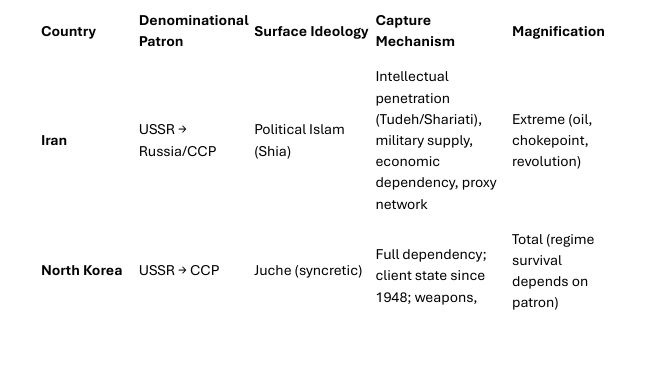


The Pattern: The denomination does not care about the surface ideology of the target
state. It has captured Marxist states (Cuba), Islamic states (Iran), Ba'athist states (Syria),
Christian nationalist states (Hungary), post-apartheid democracies (South Africa), and
secular republics (various African nations). The surface ideology is the host vehicle. The
operating system underneath is always the same: dependency creation → institutional
redirection → sovereign substitution.
Why Iran Magnifies Everything: Iran combines high-value resources (oil), strategic
geography (Hormuz), a globally recognized revolutionary brand (camouflage), a distributed
proxy network (scale), and extreme Western sanctions (dependency accelerator). No other
state presents all five magnification factors simultaneously. This is why Iran appears to be a
unique problem — it is not unique; it is maximally amplified.
PART IV: OPERATIONAL MECHANICS (THE "8TH WONDER")
The denomination achieves sovereign substitution through four compounding
mechanisms. Iran illustrates each at maximum intensity, but the mechanisms are
universal.
Demographic Compounding (The Talent Pipeline)
The denomination's global talent acquisition apparatus — Thousand Talents Program,
party-aligned professional associations, academic exchanges — systematically recruits
elites whose utility flows back to the patriarchate. In Iran, the mechanism operates at two
levels:
• Inbound: Chinese and Russian technical advisors embedded in Iran's nuclear,
missile, and cyber programs
• Outbound: Iranian scientists, engineers, and military personnel trained in Russia
and China, returning with loyalties and dependencies shaped by the
denominational host environment
Fiscal Compounding (The Parallel Treasury)
Through BRI corridors, yuan-denominated trade, and sanctions-bypass infrastructure, the
denomination builds a parallel economic system in which Iran's economic survival
becomes structurally dependent on continued CCP patronage. The 2021 $400 billion
partnership is the formalization. When a state cannot sell its primary export (oil) on global
markets because of sanctions, and only one buyer remains, that buyer's denominational
logic becomes the host state's economic logic.
Jurisdictional Compounding (The Territorial Anchor)
Using the host state's own institutions — in Iran's case, the IRGC, which increasingly serves
as a conduit for Chinese and Russian strategic priorities — the denomination establishes
operational footholds that transform the host state's sovereign territory into a forward
operating base for the denomination's global strategy. Iran's military installations, ports
(Chabahar), and drone production facilities serve Chinese and Russian strategic interests
as much as Iranian ones.
Information Compounding (Canon Enforcement)
The denomination has built overlapping propaganda and censorship systems. Iranian state
media (Press TV, Tasnim) increasingly align with Russian (RT, Sputnik) and Chinese (CGTN,
Xinhua) narratives on Ukraine, Taiwan, and the broader "anti-hegemonic" front. The
coordination is not spontaneous; it reflects denominational alignment on canonical
messaging — the unified counter-narrative to Western liberal democratic discourse that all
three states propagate.
PART V: THE GLOBAL HUMAN RIGHTS RESET (THE HOSTAGE CRISIS)
The Reality of Apostasy
Orthodox Atheist Marxism forbids exit. In the CCP system: formal Party exit is punitive;
organized dissent is criminalized; independent information access is blocked by the Great
Firewall; professional destruction awaits deviationists. In Iran, the system replicated these
mechanics using Islamic vocabulary: dissent is framed as "corruption on earth" (mofsed-e
filarz), a capital offense; the IRGC functions as an inquisition enforcing doctrinal
conformity; internet censorship mirrors Chinese infrastructure (Iran's filtering technology
was partly supplied by Chinese firms).
The surface vocabulary differs. The conscription mechanics are identical.
The Hostage Framework
Both the Iranian and Chinese populations are born into systems that:
• Mandate ideological conformity
• Criminalize organized opposition
• Restrict information access
• Punish exit with imprisonment, professional destruction, or death
These are not voluntary political communities. They are trans-generational hostage
situations maintained by the denomination's monopoly on coercive force.
The "Hotel California" Allies
Both Iran and the CCP operate bifurcated systems: liberal facades for foreigners (trade, investment, cultural exchange) to maintain economic ties, and strict internal conscription for citizens (no right to organize, no right to uncensored information, no right to challenge the canon). The same state that hosts international business conferences runs prison systems for ideological dissidents.
The Reset
Democratic states must pivot from defending the fiction that Iran's problems originate in Islam (which protects the denominational substrate) to recognizing that Iran is a captured state whose institutional pathology is maintained by its relationship with Orthodox Atheist Marxism — first Soviet, now Russo-Chinese. The strategic implication is profound: pressure on Iran alone will fail if the denominational relationship continues. The capture mechanism must be addressed.
PART VI: ACTIONABLE COUNTERMEASURES FOR THE STATE
The Jurisdictional Monopoly Doctrine
Constitutional governance is the sole source of law. States must prohibit foreign
denomination-linked entities from operating parallel disciplinary or surveillance structures.
For Iran-specific application:
• Map and disrupt IRGC-Quds Force networks operating as denomination proxy
infrastructure in host nations
• Dismantle Chinese overseas police stations and "mediation centers" that extend
denominational jurisdiction into diaspora communities
• Block the transfer of Chinese surveillance technology to denominational client
states
Fiscal & Territorial Sovereignty
• Require full disclosure of denomination-linked funding flowing into all
organizations — including those masquerading as purely religious or cultural
entities
• Subject all Belt and Road, Russian energy, and denomination-linked
investments to national security review accounting for party-state direction
• Establish sanctions architecture that targets the denominational relationship,
not just the surface ideology — meaning secondary sanctions on entities
facilitating the Iran-China-Russia dependency triangle, not just on Iran's nuclear
program
• Revoke tax-exempt status for any organization functioning as a closed-loop
channel routing resources to the denomination's parallel treasury
The "Sieve" Audit — Expanded for the Iran Case

Apostasy Protection and Capture-Exit Programs
Create legal protections, asylum pathways, and resettlement programs for:
• Former CCP members, IRGC personnel, and denomination affiliates seeking to defect
• Iranian dissidents targeted by both the Tehran regime and the denomination's transnational repression apparatus (which includes CCP surveillance of Iranian diaspora via WeChat and Chinese-built telecom infrastructure)
• Intelligence defectors who can map the denominational capture architecture
Information Infrastructure Defense
• Expose the denominational relationship publicly: Western publics associate Iran
exclusively with Islam because they have been told to. Systematic public
communication showing the Iran-Russia-China structural axis — with documented
evidence of weapons transfers, economic dependency, UN voting coordination, and
shared propaganda infrastructure — reframes the public understanding from "Islam
vs. the West" to "denominational capture vs. democratic sovereignty"
• Protect diaspora communities from transnational repression by both Tehran and the
CCP
• Counter the coordinated RT/CGTN/Press TV narrative ecosystem with verified,
multilingual content that reveals the denominational template
The Ultimate Strategic Lever: Breaking the Dependency
Iran's relationship with the denomination is sustained by Western sanctions. Every
sanction that cuts Iran off from alternative economic partners deepens the denomination's
grip. A strategic recalibration is required:
• Condition-based sanctions relief that offers Iran an alternative to denominational
dependency — not unconditional normalization, but a pathway that gives the
Iranian state an economic option other than the CCP
• Support for Iranian civil society that is not regime-change adjacent but
sovereignty-positive — empowering the elements of Iranian society that recognize
the denomination's capture and seek to restore genuine independence
• Address the denominational relationship directly in any negotiation with Tehran:
the goal is not merely constraining Iran's nuclear program but restructuring Iran's
external dependencies away from the Orthodox Atheist Marxist axis
CONCLUSION FOR BRIEFINGS
"Iran's problem is not Islam. Iran's problem is the same problem every captured state has: a
relationship with Orthodox Atheist Marxism that has hollowed out its sovereign institutions
and redirected them to serve an external denomination's strategic logic. Iran shows this
most clearly — not because it is unique, but because the magnification factors are extreme.
Oil, geography, revolutionary symbolism, proxy networks, and forty-five years of sanctions
driven dependency acceleration have made Iran the world's most visible case of
denominational sovereign substitution.
If we continue diagnosing Iran as an Islamic problem, we will continue prescribing Islamic
remedies — religious dialogue, interfaith engagement, cultural exchange. These address
the surface and leave the substrate untouched. If we diagnose Iran correctly — as a
captured state whose pathology is maintained by its relationship with the CCP
denomination and the residue of Soviet-era structural capture — we can design
interventions that actually target the mechanism.
The same template is being applied, at lower magnification, to states across every
continent. The denomination does not care whether the surface ideology is Islamic,
Christian nationalist, Ba'athist, or Bolivarian. The operating system underneath is always
the same: dependency creation → institutional redirection → sovereign substitution. Iran is
the loudest alarm. We should listen to it not as a case study in religious extremism, but as
the clearest available diagram of a global capture architecture that is already at work
everywhere — including within our own institutions.
ALL AMERICAN CITIZENS MUST KNOW THE STAKES. AS PREVIOUS PRESIDENTS WOULD
NOT ADDRESS THESE TRUTHS, BUT MAYBE THE INFILTRATION OF ORTHODOX ATHEIST
MARXIST IN AMERICAS INTELLIGENCE AGENCIES AND FBI BLOCKED ASSESSMENTS
SUCH AS THESE TO THEM. WE SHOULD ALL BE THANKFUL TO PRESIDENT TRUMP
VIEWS
61.1k