TRUMP STRIKES THE DICTATOR: U.S. CAPTURES MADURO IN BOLD OPERATION THAT SHAKES VENEZUELA AND THE GLOBAL ORDER

In a dramatic pre-dawn operation that has already reshaped the geopolitical landscape of the Western Hemisphere, President Donald Trump announced that the United States has captured Venezuela’s longtime socialist strongman Nicolás Maduro and his wife, Cilia Flores, following a precision military assault on Caracas and surrounding regions.
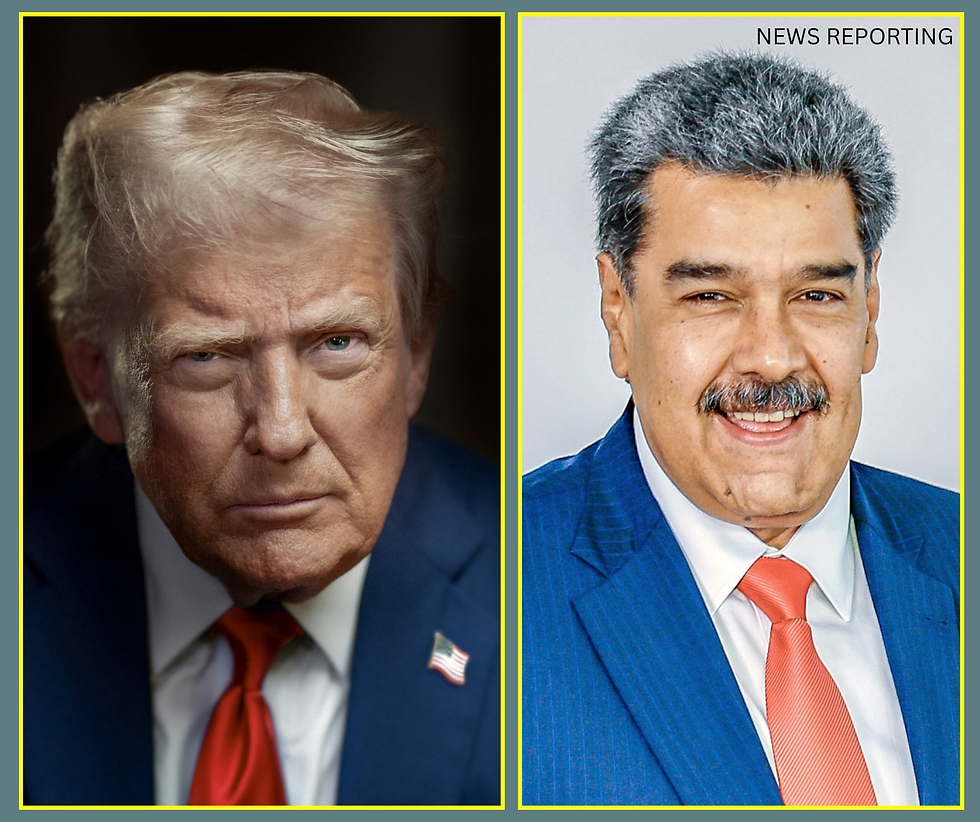
“It was a brilliant operation,” President Trump told the New York Times. “A lot of good planning, and a lot of great, great troops and great people.” Shortly thereafter, Trump confirmed on social media that U.S. forces had launched what he described as a “large-scale strike against Venezuela,” with further details to be unveiled at a press conference from his Mar-a-Lago residence.
According to U.S. media reports, Maduro was apprehended by elite American forces—specifically members of Delta Force, the same unit credited with eliminating ISIS leader Abu Bakr al-Baghdadi in 2019. The symbolism was unmistakable: America treating a narco-socialist dictator in its own hemisphere with the same seriousness once reserved for global terror masterminds.
Explosions ripped through Caracas around 2:00 a.m. local time. Residents reported low-flying aircraft, the rumble of missile strikes, and smoke rising from key military installations. Among the reportedly targeted sites were the La Carlota military airfield in the heart of the capital and the sprawling Fuerte Tiuna military base—long believed to be Maduro’s stronghold.
Eyewitnesses described panic and disbelief. “The whole ground shook,” said one resident. “We heard explosions and planes in the distance.”
Venezuela’s vice president, Delcy Rodríguez, appeared on state television in a tense telephone interview, implicitly confirming the capture of Maduro and Flores. She demanded “proof of life” and accused the United States of murdering innocent Venezuelans—claims that echoed the familiar script of every collapsing authoritarian regime confronted by reality.
“At this moment Venezuela is calm,” Rodríguez insisted, even as smoke rose behind the regime’s carefully curated broadcasts.
For more than two decades, Venezuela has been ruled by the ideology of Chavismo, launched by socialist revolutionary Hugo Chávez in 1999 and carried forward by Maduro after Chávez’s death in 2013. What began as populist rhetoric quickly devolved into economic ruin, mass starvation, political imprisonment, and the destruction of one of Latin America’s most resource-rich nations.
Under Maduro, Venezuela became a narco-state, a client regime of Havana, Tehran, Moscow, and Beijing, and a hub for drug trafficking that poisoned communities far beyond its borders—including inside the United States.
President Trump has long argued that Maduro was not merely a foreign tyrant but a direct national security threat to America.
This operation appears to be the culmination of a five-month pressure campaign that included tightened sanctions, naval deployments off Venezuela’s northern coast, targeted strikes on alleged drug-trafficking vessels, and the seizure of sanctioned oil tankers. Unlike previous administrations that relied on statements and summits, Trump relied on strength.
Venezuela’s defense minister, Vladimir Padrino López, released a defiant video accusing the United States of a “criminal regime change operation” and claiming Venezuelan sovereignty had been violated.
“This invasion represents the greatest outrage the country has ever suffered,” he declared, urging citizens and soldiers to form an “indestructible wall of resistance.”
But for millions of Venezuelans who have fled hunger, repression, and lawlessness, the real outrage occurred long before American aircraft appeared in the sky. It was the slow-motion destruction of a nation by socialist corruption, rigged elections, and Cuban-style totalitarian control.
The regime also accused the U.S. of attacking civilian targets and seeking control of Venezuela’s oil and mineral wealth—an argument often recycled by authoritarian governments desperate to deflect from their own crimes.
Predictably, left-wing leaders across the region rushed to defend Maduro. Colombian president Gustavo Petro claimed Caracas was being bombed with missiles and called for an emergency session of the UN Security Council.
Cuba’s communist ruler, Miguel Díaz-Canel, denounced the U.S. action as “state terrorism” and an assault on “Our America”—a phrase long used by Marxist movements to justify repression under the banner of anti-imperialism.
Notably absent from their statements was any mention of Venezuela’s political prisoners, its starving children, or the millions forced into exile.
This operation fits squarely within President Trump’s broader worldview: American power exists not to apologize, but to protect U.S. interests and confront evil directly. Unlike the failed interventions of the past—bogged down by nation-building fantasies and bureaucratic paralysis—Trump’s approach has been decisive, targeted, and unapologetic.
By capturing Maduro rather than negotiating endlessly with him, Trump sent a clear message to every rogue regime: sovereignty does not shield criminality, and tyranny in America’s backyard will no longer be tolerated.
WHAT COMES NEXT FOR VENEZUELA?
With Maduro removed, Venezuela now stands at a crossroads. The collapse of the regime’s central figure creates an opening—one that could lead either to chaos or to long-overdue liberation.
Key questions remain unanswered:
Who will assume interim control?
Will political prisoners be released?
Will free elections finally be held?
Will Venezuela break free from Cuban and Iranian influence?
For the first time in years, those questions are no longer theoretical.
January 3, 2026, may be remembered as the day American resolve returned to the Western Hemisphere. While global elites clutch their pearls and socialist leaders cry “imperialism,” millions of ordinary people—especially those crushed under authoritarian rule—are watching something else unfold.
They are watching a United States led by a president who does not bluff.