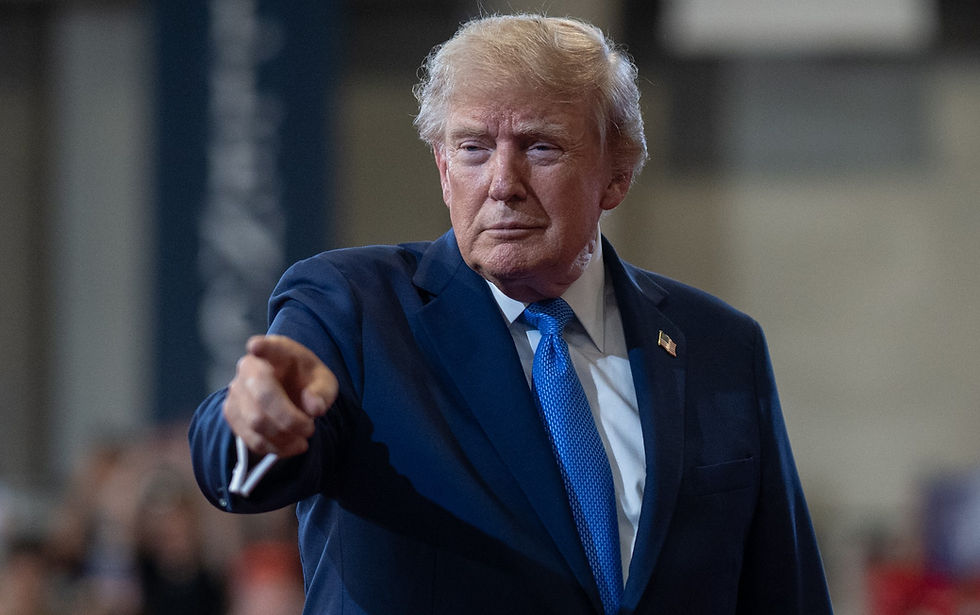
Kinzinger Attacks Trump Over Flagpole Remarks as President Faces Pressure Over Iran War

WASHINGTON — President Donald Trump’s remarks about new American flagpoles at the White House became the latest target of former Republican congressman Adam Kinzinger on Wednesday, with the CNN commentator arguing that the president appeared more interested in discussing improvements to the White House grounds than demonstrating the seriousness Kinzinger believes the continuing conflict with Iran demands.
But the criticism also highlighted a familiar divide in Washington: Trump was talking about a symbol of American pride and improvements to the nation’s most famous residence, while one of his longtime political adversaries saw the moment as evidence of something much more troubling.
During a tour of renovation work at the White House, Trump proudly pointed reporters toward one of the flagpoles installed during his administration.
“I donated the flagpoles, one on each side, because the White House didn’t really have an appropriate American flag,” Trump said.
The president then turned to the construction itself, describing the pole as “top of the line” and emphasizing its tapered design.
“I’m very good at flagpoles,” Trump remarked.
It was vintage Trump: part businessman, part builder and part president, taking reporters through construction details with the enthusiasm of someone who has spent much of his life in real estate.
Reuters reported that Trump also showed journalists a new granite helicopter landing area and discussed landscaping and other improvements around the White House. The president briefly answered questions concerning Iran and North Korea during the tour before returning to the construction projects.
For Kinzinger, however, the scene was anything but amusing.
Appearing on CNN, the former Illinois Republican and Air Force veteran questioned Trump's remarks and suggested Americans had become accustomed to presidential behavior that once would have seemed extraordinary.
Kinzinger argued that the country is living through a serious international conflict while thousands of American sailors have spent months away from their families.
His sharpest criticism centered on the USS Abraham Lincoln.
The carrier has now been deployed for more than 250 days amid the Iran conflict. CNN previously reported that the extended deployment has generated concerns about morale and conditions aboard the vessel. Defense Secretary Pete Hegseth has said some of the problems have been misrepresented while expressing respect and gratitude for the sailors serving aboard the carrier.
Kinzinger said Wednesday that those sailors were “working their tail off for the American people” and argued that Trump did not appear to be treating the situation with sufficient gravity.
“And you have a president that doesn’t seem to be taking this very seriously,” Kinzinger said.
That accusation comes from a politician who has spent years publicly battling Trump.
Kinzinger, once a Republican congressman from Illinois, emerged as one of Trump's most prominent Republican critics and has since become a CNN political commentator. His latest comments therefore arrive not as an isolated disagreement but as another chapter in a long-running political feud.
Still, behind the television confrontation lies a real military story.
The USS Abraham Lincoln has endured an unusually long deployment. The Associated Press reported Thursday that the USS George Washington has arrived in the Middle East to relieve the Lincoln after the latter spent more than 250 days deployed.
That means thousands of American sailors who have carried an enormous operational burden may finally be moving closer to the end of a grueling mission.
The episode also illustrates the unusual political environment surrounding the Iran conflict.
Trump has long cultivated a public style dramatically different from traditional presidents. He moves rapidly between major geopolitical questions and seemingly mundane details — tariffs and architecture, military operations and marble, foreign leaders and flagpoles.
His political enemies portray those transitions as evidence that he is distracted.
Trump's political appeal, however, has often rested on precisely the opposite interpretation: that he refuses to adopt Washington's carefully scripted presidential persona.
There is also symbolism in what Trump was discussing.
The American flag is not merely another decoration on the White House lawn. It represents the country whose sailors aboard the Abraham Lincoln have spent months serving thousands of miles from home.
Installing prominent American flags at the White House and commanding military operations abroad are obviously responsibilities of vastly different magnitude. But discussing one does not by itself establish indifference toward the other.
That distinction is important.
Kinzinger is entitled to question the administration's handling of the Iran conflict, particularly as the deployment of American personnel stretches onward. Congress and the press likewise have legitimate reasons to scrutinize military objectives, troop welfare, strategy and the eventual path home.
But Trump's enthusiasm for a White House construction project cannot, on its own, answer those questions.
The more consequential test will be what happens next in Iran.
Can the administration clearly define America's objectives? Can it protect American forces while preventing an indefinite military commitment? And can sailors who have spent more than 250 days deployed finally return safely to their families?
Those questions will matter long after Wednesday's argument over a tapered flagpole disappears from the cable-news cycle.
For the men and women aboard America's ships, the story is not about television personalities trading criticism in Washington.
It is about completing the mission — and coming home.