
Epistemological Bridge How Knowledge Foundations Reveal Religious Structure Across Ideologies

DISCLAIMER: The views and opinions expressed in this content are those of the author and do not necessarily reflect the official policy or position of Capitol Times Media.
By Scott Shields - Contributing Writer - Capitol Times Media - From A Brilliant Friends Assessment Of Scott's White Papers
When we examine contemporary ideologies through an epistemological lens, something remarkable emerges: systems we typically categorize as "political philosophy," "scientific method," or "secular ethics" all share a structural feature with traditional religion. They each begin with an epistemological claim about how Truth is accessed—and this epistemological foundation precedes all other commitments.
The Architecture of Truth
In the architecture of Truth, epistemology sits above all else. Before we can claim to know
what is real (Metaphysics), how to reason correctly (Logic), or what is right (Ethics), we
must first answer how we know what counts as Truth.
Without an epistemological foundation, Metaphysics becomes fantasy. Without verified
Truth, Ethics becomes preference. Without valid methods, Logic becomes meaningless
symbol manipulation.
This is precisely why we allow epistemology to be debated within philosophy rather than
attacked by philosophy. Epistemology isn't separate from philosophy, it is philosophy's
master discipline. The debates between rationalists and empiricists, skeptics and
dogmatists, postmodernists and realists aren't external attacks on knowledge; they are
internal stress-tests ensuring that whatever metaphysical or ethical system follows rests
on examined foundations.
Three Denominations of Atheistic Faith Scott Shields work extends this epistemological framework further. He argues that contemporary "atheistic" belief systems aren't alternatives to religion, they're religious denominations distinguished primarily by their epistemological claims about how to access Truth.
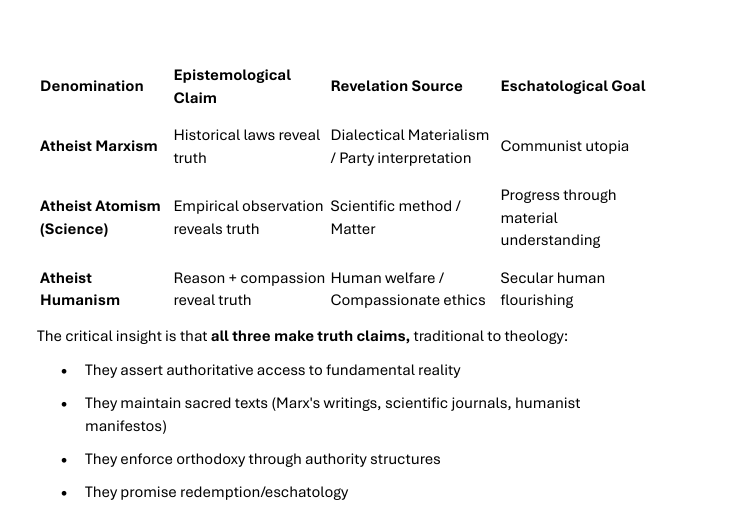
The difference from traditional theism isn't structural, it's only that the "revelation" comes from historical laws, empirical data, or human reason rather than divine scripture. Where Philosophy and Religion Converge This is where Shields' epistemological first argument connects to the philosophical discussion we began with. Traditional philosophy treats epistemology as one branch among equals within metaphysics, ethics, logic, and aesthetics, a classification dating back to Aristotle and medieval taxonomy. Shields challenges this organization. His argument: once you make an epistemological claim about how to access Truth, you've entered theological territory, regardless of whether "God" appears in the equation. Traditional theistic religions: "Truth is revealed through Scripture/divine revelation."
• Atheist Marxism: "Truth is revealed through Historical Laws/Party interpretation."
• Atheist Atomism: "Truth is revealed through Scientific Observation."
• Atheist Humanism: "Truth is revealed through Human Reason/Compassion."
The structure is identical. Only the source differs.
Incompatible Epistemologies
Because each denomination makes exclusive epistemological claims, they cannot all be simultaneously true:
• A Marxist trusting interpretation, rejects empirical claims contradicting dialectical necessity
• A scientific atomist trusting only empirical verification rejects humanist ethics lacking measurement
• A humanist trusting compassionate intuition rejects both if they fail to serve flourishing
This mutual exclusivity is the hallmark of competing religious denominations, not complementary secular frameworks. Important Discla
1. Academic Consensus: Classification of atheism, Marxism, or science as "religious denominations" lacks mainstream acceptance in constitutional law, political theory, and religious studies. These remain minority positions. This consensus itself reflects institutional inertia from Aristotle through medieval scholasticism to modern departmental organization, as epistemology has been categorized as one domain among equals within philosophy rather than as the governing discipline. Shields' framework directly challenges this centuries old organizational hierarchy.
2. Constitutional Law: While Shields argues the Establishment Clause prohibits government endorsement of any belief system (theistic or materialist), this interpretation conflicts with established First Amendment jurisprudence, which distinguishes between religious and non-religious doctrines. This legal distinction presupposes that epistemological questions about "what counts as Truth" belong to private philosophical domains, not state-regulated categories, precisely the institutional drift Shields identifies. Courts operate on the assumption that philosophy and epistemology are separate questions when Shields argues they are inseparable.
3. Philosophical Tradition: Most philosophers continue treating epistemology as one domain among others within philosophy, not as a master discipline governing all intellectual inquiry. This tradition traces back to Aristotelian and medieval taxonomies that placed epistemology (or proto-epistemology) within theoretical philosophy rather than above it. Huge mistake according to Shields.
The Constitutional Implication (As Presented by Shields)
Shields takes his argument further into constitutional analysis. If all three systems are religious denominations, then the First Amendment's Establishment Clause would theoretically prohibit government endorsement of any of them, whether that's mandating Marxist orthodoxy in schools, treating scientific materialism as state doctrine, or enshrining humanist values as official policy. He advocates for shifting analysis of these systems from political science departments to theology and religious studies, where comparative religious frameworks will better examine their structural parallels to established faith traditions.
Toward Epistemological Clarity
Whether one accepts Shields' conclusions depends largely on whether they accept his premise: "that any system claiming authoritative access to Truth via a specific epistemological method constitutes a religious structure." What remains valuable: examining epistemological foundations before metaphysical or ethical commitments.
This is not a new insight, it echoes Descartes' Meditations, Kant's Critique of Pure Reason, and the analytic tradition's prioritization of justification and meaning. Shields acknowledges this in his white papers.
The question isn't whether we should stress test our foundations. It's whether we recognize that the act of stress-testing itself presupposes epistemological commitments. And perhaps more provocatively: whether we're willing to confront the possibility that our entire institutional arrangement, academic departments, legal frameworks, philosophical curricula, may have drifted into a structure that obscures more than it reveals about how knowledge actually works and why Marxist propaganda became the religious cult of Godlessness has spread the last century.
You cannot be a practicing spiritual person and also belong to the Atheist Marxist religion otherwise you are a spiritual Bipolar person and that is not an easy indoctrination to come out of. Shields says he is here to help people come out of the cult as he is credited for stating. Atheist Marxism is the Mind Virus (Pathogen) that leads to the societal cancer of religious Marxist Socialism (Nazism) and metastasizes into Communism (the most dangerous cult to one’s own human born condition).
VIEWS
3.1K


