
America Isolationist Were Correct Prior World War II. You Cannot Feed Religious Socialist Marxist or Atheist Marxist Communist Economy and Expect It To Be Peaceful

Updated: Jul 24
By Scott Shields – Contributing Writer – Capitol Times Media Inspired by the analysis of institutional conscription and historical economic patterns
I. The Historical Record: When Economic Support Fuels Aggression
History offers a stark warning that is often ignored in the pursuit of diplomatic engagement: you cannot subsidize a system designed for conquest and expect it to abandon its designs.
The debate over American isolationism prior to World War II remains one of the most contentious chapters in U.S. foreign policy. Traditional historiography often casts isolationists as timid or indifferent to tyranny. However, a closer examination of the economic mechanics of the 1930s suggests a different conclusion. The isolationists correctly identified that engaging economically with regimes whose structural logic required expansion was not an act of peace-building, but of resource provisioning.
The Great Depression created a global vacuum of stability. As trade contracted (falling ~66% by 1933 due to protectionist measures like Smoot-Hawley), nations turned inward. But where some nations turned inward to heal, others turned outward to feed their insatiable appetite for resources. The Library of Congress notes that "political chaos and economic uncertainty, in turn, gave rise to dictatorial regimes... These regimes pushed the world to war in the 1930s."
The critical error was not merely failing to stop aggression militarily; it was the assumption that economic integration could moderate Religious Socialist Marxist and Atheist Communist Marxist ideological societies.
The isolationist argument before WWII was simple and accurate: You cannot feed a machine designed to consume fuel indefinitely without it eventually consuming you.
II. The Structural Logic of Expansionist Ideologies
Why did engagement fail? Because the economic systems in question were not built on the logic of mutual benefit. They were built on the logic of extraction.
Institutional Conscription vs. Market Freedom
As analyzed in recent Capitol Times coverage, systems rooted in "institutional conscription" demand subordination of individual liberty to organizational goals. Whether termed "Religious Socialist Marxist" or "Atheist Marxist Communist," the structural outcome is identical:
Opacity: Centralized control requires hiding data (e.g., GDP figures, unemployment rates, resource reserves).
Extraction: Surplus is redirected to state power (military, party apparatus) rather than consumer welfare.
Expansion: Without internal growth (consumption), the system requires external growth (territory/resources) to survive.
In the 1930s, when the U.S. and Britain maintained trade barriers, they starved the expansionist engines. When engagement resumed (post-WWII with the Marshall Plan), it was directed toward nations already liberated from this structural logic. The lesson is clear:
Engagement works only after the Marxist ideology has been defeated so economic isolation of Religious Socialist Marxist and Atheist Communist Marxist can accept truths from years of cult indoctrination. But the cat is out of the bag and we are on the path of World War III unless China states loud and Clear Atheist Marxism Is dead in China and we will not do business with other Marxist Counties, Atheist or Religious. Xi would get a noble peace prize following Gorbachev's courage and the conflicts around the world would diminish and peace and prosperity to all nations would accelerate very quickly.
Below explains:
III. China's Current Economic Condition: What the Data Shows
Here's what current reporting confirms about China's economy as of mid-2026:
Key Economic Indicators
20192020202120222023202420252026 H12027 proj.Period02468GDP Growth (%)China GDP Growth Rate, 2019–2027Slowing from ~6% pre-pandemic to 4.3% in Q2 2026, projected 4.1% for 2027
According to AP reporting, China's economy grew at just 4.3% annualized in Q2 2026—the slowest since late 2022. Officials project only 4.1% growth for 2027. Meanwhile:
•Fixed-asset investment fell 5.7% year-on-year in H1 2026
•Retail sales grew a mere 1.3%—signaling dangerously weak domestic consumption
•The property sector remains in deep distress, echoing Japan's 1990s collapse
•The IMF warned in August 2024 that China's debt trajectory was "dangerous"
•Forbes reports comparisons to Japan's "Lost Decade"—but potentially worse, because China faces demographic decline simultaneously
However, there's a critical countervailing trend: Chinese exports surged 17.6% in H1 2026, with June alone seeing 27% growth—driven by EVs, semiconductors, and AI-related products. Exports to Southeast Asia jumped ~35%, pushing two-way trade with ASEAN near $982 billion.
The Paradox: Domestic Decay + Export Surge
This is the paradox that makes China's situation structurally different from Japan's Lost Decade. Japan turned inward and stagnated peacefully. China is experiencing domestic decay while simultaneously accelerating external economic expansion and military posturing.
The isolationists were correct prior to World War II. You cannot feed a Religious Socialist Marxist or Atheist Marxist Communist economy and expect it to be peaceful. The system is designed to consume. The only question is whether we let it consume our prosperity first.
IV. The Correlation: Mapping 1930s Patterns onto 2020s China
Structural Comparison Matrix

The Critical Difference: Speed of Transmission
The 1930s unfolded over a decade. China's economic crisis is unfolding in an era of instantaneous capital flows, global supply chains, and nuclear deterrence. The hypothetical compression of the timeline is itself a risk factor—decisions that took years in the 1930s could take weeks or months today.
V. Regional Scenarios
A. Taiwan: The Manchuria Analogy
Historical parallel: Japan invaded Manchuria in September 1931, during the depths of the Depression. The invasion was driven partly by military officers who believed territorial expansion would solve Japan's economic crises—resource acquisition, domestic distraction from unemployment, and restoration of national prestige.
Current signals (from July 2026 reporting):
•Taiwan reported 55 Chinese government vessel sightings in June 2026, up from 30 in May—an 83% increase
•Some Chinese coast guard vessels are converted former naval destroyers, repainted for coast guard use
•China test-fired a submarine-launched ballistic missile from the South China Sea into the Pacific
• A full-scale replica of a US Arleigh Burke-class destroyer was built in the Xinjiang desert for missile testing
•Taiwan is planning drills simulating a blockade scenario
•President Lai Ching-te stated on July 19, 2026: "Democratic Taiwan must not become 'China's Taiwan'"
•Market odds for a China-Japan military clash before 2027 stand at 7.5%, China-Philippines at 11%
If China's economic deterioration accelerates beyond the current "slow bleed," the temptation to manufacture a Taiwan crisis as domestic distraction intensifies. The coast guard deployments and missile tests may represent graduated escalation—not preparation for immediate invasion, but testing thresholds the way Japan tested League of Nations resolve in Manchuria.
Jun 2025 Jun 2026 May 2026 Month - Vessel Sightings Chinese Vessel Sightings Around Taiwan, 202683% monthly increase from May to June signals escalating pressure
B. Southeast Asia: The Co-Prosperity Sphere Echo
Historical parallel: Japan's "Greater East Asia Co-Prosperity Sphere" was framed as liberation of Asian nations from Western colonialism. In practice, it was economic conscription—resource extraction under military coercion.
Current signals:
•China-ASEAN two-way trade reached ~$982 billion in the past year
•Chinese exports to Southeast Asia grew ~35% year-on-year
•China is building port infrastructure across Africa (e.g., $900M port in Angola, Simandou iron ore logistics in Guinea)
•South China Sea tensions escalating—US Secretary Rubio criticized Beijing's "dangerous" actions in July 2026
•The Philippines reported injuries from encounters with Chinese vessels
C. Africa and Latin America: The Resource Front
Historical parallel: The Great Depression intensified competition for raw materials. Italy invaded Abyssinia (Ethiopia) in 1935 seeking resources and imperial prestige to compensate for domestic economic failure.
Current signals:
•China continues large-scale infrastructure investments in Africa despite domestic slowdown ($900M Angola port, Simandou iron ore project in Guinea)
•Latin American debt markets are "busier than ever in 2025" as countries seek external financing
•The IEA reported that China and Indonesia account for over 75% of refined supply growth for critical minerals
•Investment in critical minerals mining fell 9% globally in 2025 due to geopolitical tensions and export controls
China's domestic economic pain will actually accelerate its resource acquisition strategy in the Global South. Unable to rely on domestic consumption, Beijing doubles down on controlling supply chains for minerals essential to the global energy transition—creating neo-colonial dependency networks that mirror 1930s resource competition. China is the colonialist of this century and has been for the last two decades.
D. Europe and the United States: The Appeasement Trap
Historical parallel: Throughout the 1930s, Britain and France repeatedly accommodated German and Japanese aggression rather than risk confrontation. The logic was economic—Europe was still recovering from depression and could not afford military spending. This appeasement emboldened aggressors.
Current signals:
•Developed-market sovereign debt projected to hit a record $75.8 trillion by end of 2026 (Fitch Ratings, July 2026)
•The US is simultaneously managing conflicts with Iran, trade disputes with China, and domestic political polarization
•Europe remains dependent on Chinese markets for major industries (German automakers, French luxury)
•Western response to Chinese military escalation has been rhetorical rather than consequential
Debt-burdened Western governments may lack fiscal capacity to respond decisively to Chinese aggression—mirroring the 1930s appeasement dynamic. The economic interdependence that was supposed to prevent conflict (the "responsible stakeholder" theory) becomes the mechanism that prevents response.
VI. The Causal Chain: Trajectory
Drawing the parallel explicitly:
China GDP Growth
4.3%
▼From ~6% pre-pandemic
Fixed-asset investment
-5.7%
▼YoY decline H1 2026
Export surge
+17.6%
▲H1 2026, +27% in June
Taiwan vessel sightings
55
▲+83% from May
The Sequence
Phase 1 — Economic Distress (Present)
•Property collapse, debt crisis, consumption collapse
•Export surge as compensating mechanism
•Government responds with repression rather than reform (Xi's "top-down economic plan")
Phase 2 — Domestic Legitimacy Crisis (Near-term)
•The Communist Party's legitimacy rests on delivering prosperity. When growth falls below the implicit social contract threshold (~5%), alternative legitimation is needed
•Nationalism becomes the substitute for economic performance
•Historical grievances (century of humiliation, Taiwan "separatism," Western containment) are amplified through state media
Phase 3 — Graduated Military Escalation (Underway)
•Coast guard deployments, missile tests, desert missile range construction
•Not yet war, but testing resolve—measuring Western response thresholds
•Each provocation that goes unanswered recalibrates the perceived cost of further escalation
Phase 4 — Economic Weaponization
•Export dependencies weaponized (rare earth controls, pharmaceutical supply chains, semiconductor materials)
•Belt and Road infrastructure becomes strategic leverage rather than development assistance
•Countries dependent on Chinese trade face implicit coercion to align politically
Phase 5 — Territorial Crisis
•Taiwan blockade or "quarantine"—using coast guard rather than navy to create plausible deniability
•South China Sea exclusion of foreign vessels
•Korean Peninsula pressure if North Korea is leveraged
Phase 6 — Global Conflict or Containment
•Either the international community mobilizes sufficient economic and military deterrence to halt escalation
•Or graduated provocations cumulate into a confrontation that becomes uncontrollable
Accelerating Factors

VIII. The Pattern Is Visible, the Outcome Is Not
History rhymes. It does not repeat exactly.
The Great Depression produced WWII because economic desperation empowered leaders who saw territorial aggression as the solution to domestic failure. The mechanisms were: nationalism substituted for prosperity, military escalation substituted for economic reform, and Western democracies were too economically exhausted to respond decisively.
China's current economic crisis contains all the structural ingredients of this pattern:
•A one-party state whose legitimacy depends on growth it can no longer deliver
•A leader with unlimited tenure and no institutional checks
•An export-dependent economy being squeezed by Western tariffs
•A military being steadily escalated against a democratic neighbor (Taiwan)
•A global West too indebted and distracted to mount decisive deterrence
•A nationalist narrative of historic grievance and national rejuvenation
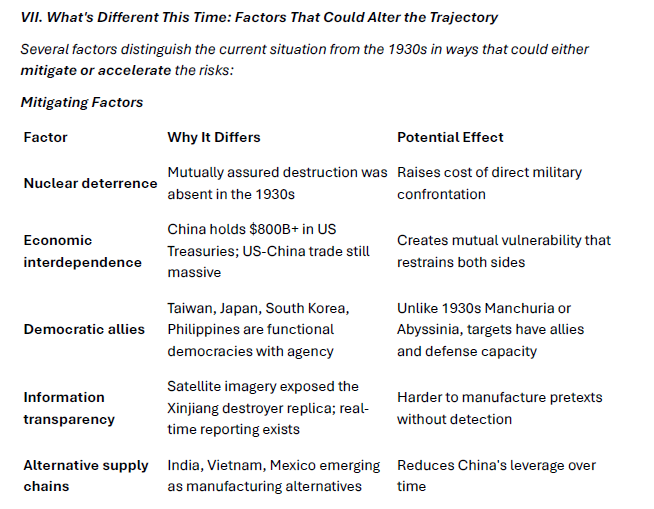
But several factors differ: nuclear deterrence, economic interdependence, democratic allies with agency, and real-time information transparency.
Whether the pattern completes itself depends on decisions not yet made—by Beijing, by Washington, by Taipei, by Tokyo, and by citizens who demand transparency and accountability from all institutions.
The lesson of the 1930s is not that economic crisis inevitably produces war. It is that economic crisis produces war when political leaders choose military expansion as the substitute for economic reform, and when the international community lacks the will or capacity to deter that choice.
Both conditions are currently in play. Neither outcome is guaranteed.
What is guaranteed is that the cost of preventing the worst outcome rises with every month the underlying economic crisis goes unaddressed. The 1930s taught that lesson at the cost of 70 million lives. The question is whether this generation can learn it without paying the same tuition.
IX. The Cost of False Engagement
The cost of ignoring the isolationist warning is measured in human lives and democratic integrity.
1. Fueling the Machine
Every ton of raw material exported to a coercive regime, every license granted for advanced technology transfer, every loan extended to opaque state-owned enterprises strengthens the infrastructure of control. In the 1930s, U.S. scrap metal and oil flowed to Japan despite the invasion of Manchuria. That trade did not stop the war; it extended the war.
Today, Western dependency on Chinese critical minerals (75%+ refined supply growth controlled by China and Indonesia) creates a similar vulnerability. If the West feeds the ecosystem, it cannot blame the ecosystem for using that energy aggressively.
2. The Opacity Trap
Authoritarian regimes thrive on information asymmetry. As discussed in the analysis of Satoshi Nakamoto’s anonymous architecture, systems designed without trust are resilient. Conversely, systems designed on opacity are fragile but dangerous.
China’s officially reported GDP figures are "widely discounted" by independent analysts. Youth unemployment data was censored. Property crisis was denied. This opacity is not
accidental; it is structural. It prevents external actors from accurately assessing risk until it is too late. The isolationists understood that without transparency, trade is blind gambling and the house always wins.
X. Consumer Protection as National Defense
This is where the lesson connects to the broader framework of transparency and accountability. The same architecture that protects individuals from financial fraud (blockchain, verifiable data) protects nations from geopolitical deception.
Satoshi Nakamoto’s creation of Bitcoin was not merely a currency; it was a statement that trust should not be centralized. A system that functions without a single authority is immune to coercion. In contrast, a system dependent on trust in a hostile regime is a security liability.
The "consumer protection" model applied to geopolitics means:
•Verify Before You Trade: Demand transparent, auditable data on economic health.
•Diversify Supply Chains: Do not allow adversarial states to hold monopoly power over critical inputs.
•Reject Opacity: Refuse partnerships with systems that hide their books.
The isolationists of the 1930s were essentially saying: "Until they show us their books and their intentions, we do not sign the check." That remains sound advice.
XI. The Lesson of History
The Great Depression did not inevitably cause World War II. But it created the conditions where economic desperation empowered leaders who saw territorial aggression as the solution to domestic failure. The mechanisms were clear: religious Socialist Marxism and Atheist Communist Marxism have the common denominator of Marxism which is not compatible with Americas Founding principles, so why feed their societies as many call - Sins In Economic Charity.
America's isolationists correctly identified that feeding such systems does not produce peace. It only produces a stronger enemy. The Marshall Plan succeeded because it rebuilt democracies capable of self-sustenance and aligned initially with Americas ideals. The mistakes of the interwar period succeeded because they hoped financial success from capitalism feeding them and their country would eventually have them state Marxism is a theocratic movement and failed economic system which eventually leads to conflict internally and outwardly.
Today, as China faces a "Lost Decade" of its own and turns to external coercion to distract from internal decay, the choice is familiar. We can feed the machine and hope it spares us. Or we can starve the mechanism of expansion and invite them into a non-Marxist global society with them helping lead the way for peace and prosperity instead of them leading the world to World War III
The isolationists were correct prior to World War II. You cannot feed a Religious Socialist Marxist or Atheist Marxist Communist economies and expect it to be peaceful. The system is designed to consume. The only question is whether we let it consume our prosperity first.
Sources: AP/Greenwich Time (China GDP data July 2026), Forbes (China-Japanification analysis 2025), Reuters (Taiwan vessel activity July 2026), Defense News (China coast guard and ICBM test July 2026), Crypto Briefing (Xinjiang destroyer replica), Library of Congress (Great Depression and WWII overview), Investopedia (economic factors leading to WWII), Fitch Ratings via Reuters (developed-market debt July 2026), IEA via Daily Sabah (critical minerals decline 2025), Carvina Capital via Digital Journal (China export data 2026), Business Insider Africa (Angola port investment), Brownfield Ag News (US-China trade decline). All projections are analytical exercises based on historical pattern recognition.
VIEWS 12k


